
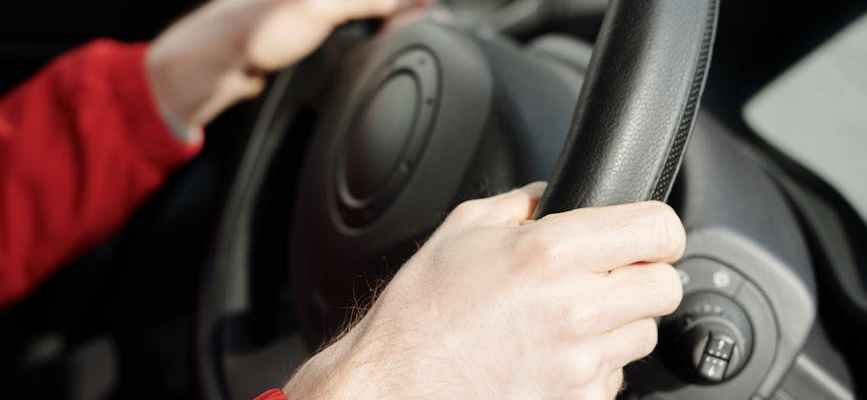
Note: With Christmas just past and the new year quickly approaching, I am sharing this summary of my adventure to obtain an Italian driver’s license.
On the evening of Friday, Nov. 14, 2025, I returned to the starting point of my road test. The examiner in the back seat had been mostly silent for the roughly 20-minute exam and had spoken only to give instructions (“pull out,” “park here,” “turn right,” “turn left,” “three-point reverse here,” etc.). My instructor had also been silent in shotgun, pointing only to clarify the direction.
The examiner circled an item on the clipboard, had me sign the form next to my name, had me check the information on a card, and handed it to me. I realized then that it was my Italian driver’s license.
As the instructor helped me retrieve my jacket and hat from the trunk, he congratulated me. He dropped off the examiner at his car and I walked home with the license secure in my pocket.
Fourteen months later, my long journey to an Italian driver’s license was a success. Almost a giddy teenager again, I showed off the license to my confreres back home and shared this Instagram post the next day.
As a graduate student in Rome, I had no serious need for an Italian driver’s license. My university, the Marianum, was down the street. With a decent public transit and the size of Rome, I could easily walk to stores and popular sites in the city. Trains and planes cover long-distance travel in Italy and the rest of Europe.
But I wanted to help my religious community by being available to drive to the train station, airport or supermarket. A flu or cold outbreak could leave the house without anyone to drive. There was also the possibility that I might celebrate a Sunday Mass at a chapel south of the city, accessible only by car.
But all the community cars have a manual transmission. In the United States, everyone my age had learned on an automatic transmission. Although I had ridden a motorcycle with a manual transmission many years ago, I realized quickly that I needed lessons to learn how to use a stick shift.
Italy mandates that a foreigner with a residency permit must have an Italian driver’s license to drive. Having such a status, I can’t use my American license as a tourist.
Because such a license is not convertible in Italy, I had to undergo the long process for applying for an Italian driver’s license. As I sought to fulfill one requirement, I found another that takes precedence. To spare everyone the excess headaches and waits, I list the priorities in the proper order.
- Italian visa
- Permesso di soggiorno
- Declaration of residency at the townhall (municipio). This is better done online through PEC (Posta Elettronica Certificata). Check after a month to see that the townhall had processed the declaration.
- Apply for an Italian identity card at the townhall. In Rome, it’s best to get an appointment through an “Open Day” (it usually occurs twice a month).
- Apply for a Tessera Sanitaria (the card for the Italian public health system).
- Choose and set an appointment with a medico basso (aka primary care provider in America) and have him/her fill out the health form for the suitability to drive.
- Bring the completed medical form to the driving school (autoscuola) so that the doctor there can sign off on the form.
- Apply at a driving school (autoscuola).
- Take classes on driving theory. Read the manual and practice questions through app.
- Pass exam on driving theory (30 questions in 20 minutes on a computer). Only three errors allowed.
- Receive learner’s permit (foglio rosso) and begin driving lessons.
- Pass exam on driving.
Each of these steps can be a whole blog entry all by itself. Overall, the process taught me patience (with bureaucracy), humility (especially taking classes on driving theory with teenagers seeking their first license) and perseverance (in learning how to use a stick shift).
When one cuts out the unnecessary waits (two extra months for a confirmation of residency and three months in the United States delaying my driving lessons), the whole process for me should have taken nine months.
With my new license, I need to drive at least weekly to become comfortable in traffic. (Can one be ever comfortable in Roman traffic?) An older Oblate suggested driving in the weekends when traffic is lighter. There are a few shrines south of Rome (Santuario della Madonna di Divino Amore & Chiesa del Martirio di San Paolo) that I had wanted to visit. I will add blog posts after I visit each one.
The rector major assigned me to take care of the community cars. New capabilities mean more responsibility.
Here are some important reminder for me and those who have an Italian driver’s license for less than three years:
- Particular speed limits on certain roads:
- Autostrada: 100 kilometers an hour
- Strada extraurbana principale: 90 kilometers an hour
- My instructor on driving theory always warns everyone: Don’t get a speeding ticket.
Stay safe on the roads.
God bless.
 Live the Essentials